

This manifesto outlines 10 actionable priorities to unlock the potential of sustainable seaweed cultivation across Europe and North America. It addresses the needs of stakeholders across the value chain, from policymakers and investors to farmers, processors, and product off-takers.
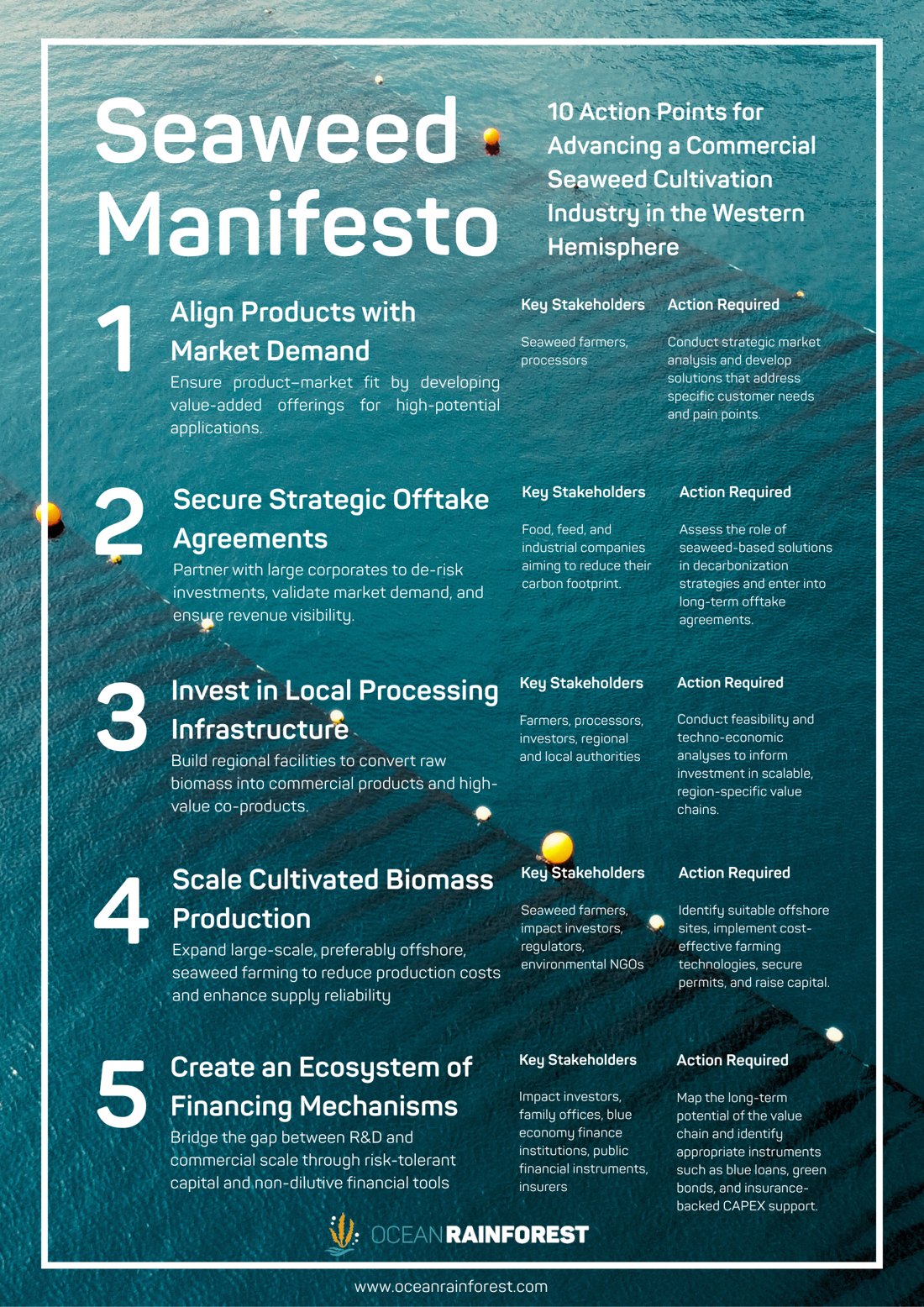
10 Action Points for Advancing a Commercial Seaweed Cultivation Industry in the Western Hemisphere
1. Align Products with Market Demand
Ensure product-market fit by developing value-added offerings for high-potential applications.
- Key stakeholders: Seaweed farmers, processors
- Action required: Conduct strategic market analysis and develop solutions that address specific customer needs and pain points.
2. Secure Strategic Offtake Agreements
Partner with large corporates to de-risk investments, validate market demand, and ensure revenue visibility.
- Key stakeholders: Food, feed, and industrial companies aiming to reduce their carbon footprint.
- Action required: Assess the role of seaweed-based solutions in decarbonization strategies and enter into long-term offtake agreements.
3. Invest in Local Processing Infrastructure
Build regional facilities to convert raw biomass into commercial products and high-value co-products.
- Key stakeholders: Farmers, processors, investors, regional and local authorities
- Action required: Conduct feasibility and techno-economic analyses to inform investment in scalable, region-specific value chains.
4. Scale Cultivated Biomass Production
Expand large-scale, preferably offshore, seaweed farming to reduce production costs and enhance supply reliability.
- Key stakeholders: Seaweed farmers, impact investors, regulators, environmental NGOs
- Action required: Identify suitable offshore sites, implement cost-effective farming technologies, secure permits, and raise capital.
5. Create an Ecosystem of Financing Mechanisms
Bridge the gap between R&D and commercial scale through risk-tolerant capital and non-dilutive financial tools.
- Key stakeholders: Impact investors, family offices, blue economy finance institutions, public financial instruments, insurers
- Action required: Map the long-term potential of the value chain and identify appropriate instruments such as blue loans, green bonds, and insurance-backed CAPEX support.
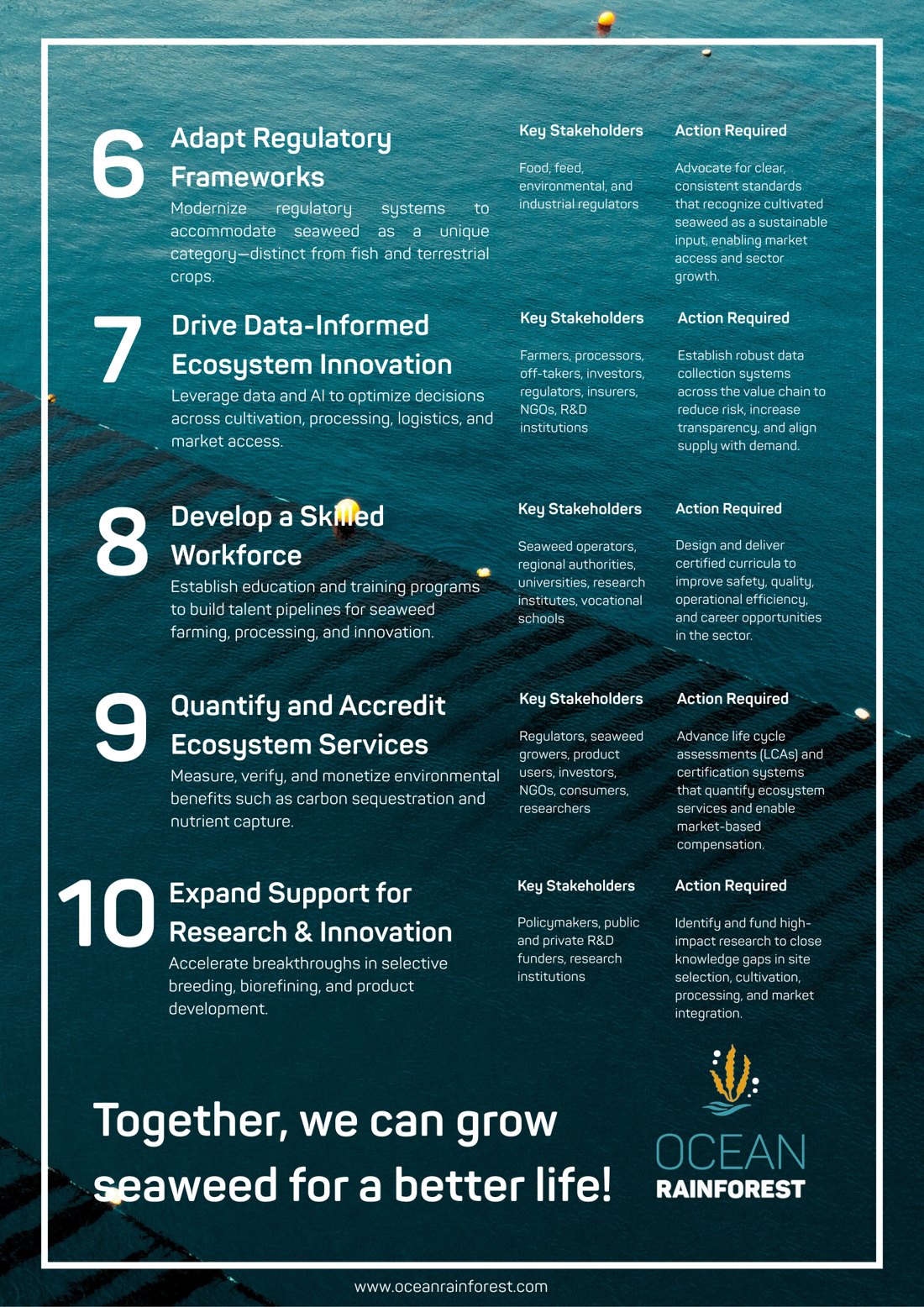
6. Adapt Regulatory Frameworks
Modernize regulatory systems to accommodate seaweed as a unique category, distinct from fish and terrestrial crops.
- Key stakeholders: Food, feed, environmental, and industrial regulators
- Action required: Advocate for clear, consistent standards that recognize cultivated seaweed as a sustainable input, enabling market access and sector growth.
7. Drive Data-Informed Ecosystem Innovation
Leverage data and AI to optimize decisions across cultivation, processing, logistics, and market access.
- Key stakeholders: Farmers, processors, off-takers, investors, regulators, insurers, NGOs, R&D institutions
- Action required: Establish robust data collection systems across the value chain to reduce risk, increase transparency, and align supply with demand.
8. Develop a Skilled Workforce
Establish education and training programs to build talent pipelines for seaweed farming, processing, and innovation.
- Key stakeholders: Seaweed operators, regional authorities, universities, research institutes, vocational schools
- Action required: Design and deliver certified curricula to improve safety, quality, operational efficiency, and career opportunities in the sector.
9. Quantify and Accredit Ecosystem Services
Measure, verify, and monetize environmental benefits such as carbon sequestration and nutrient capture.
- Key stakeholders: Regulators, seaweed growers, product users, investors, NGOs, consumers, researchers
- Action required: Advance life cycle assessments (LCAs) and certification systems that quantify ecosystem services and enable market-based compensation.
10. Expand Support for Research & Innovation
Accelerate breakthroughs in selective breeding, biorefining, and product development.
- Key stakeholders: Policymakers, public and private R&D funders, research institutions
- Action required: Identify and fund high-impact research to close knowledge gaps in site selection, cultivation, processing, and market integration.
Together, we can grow seaweed for a better life!